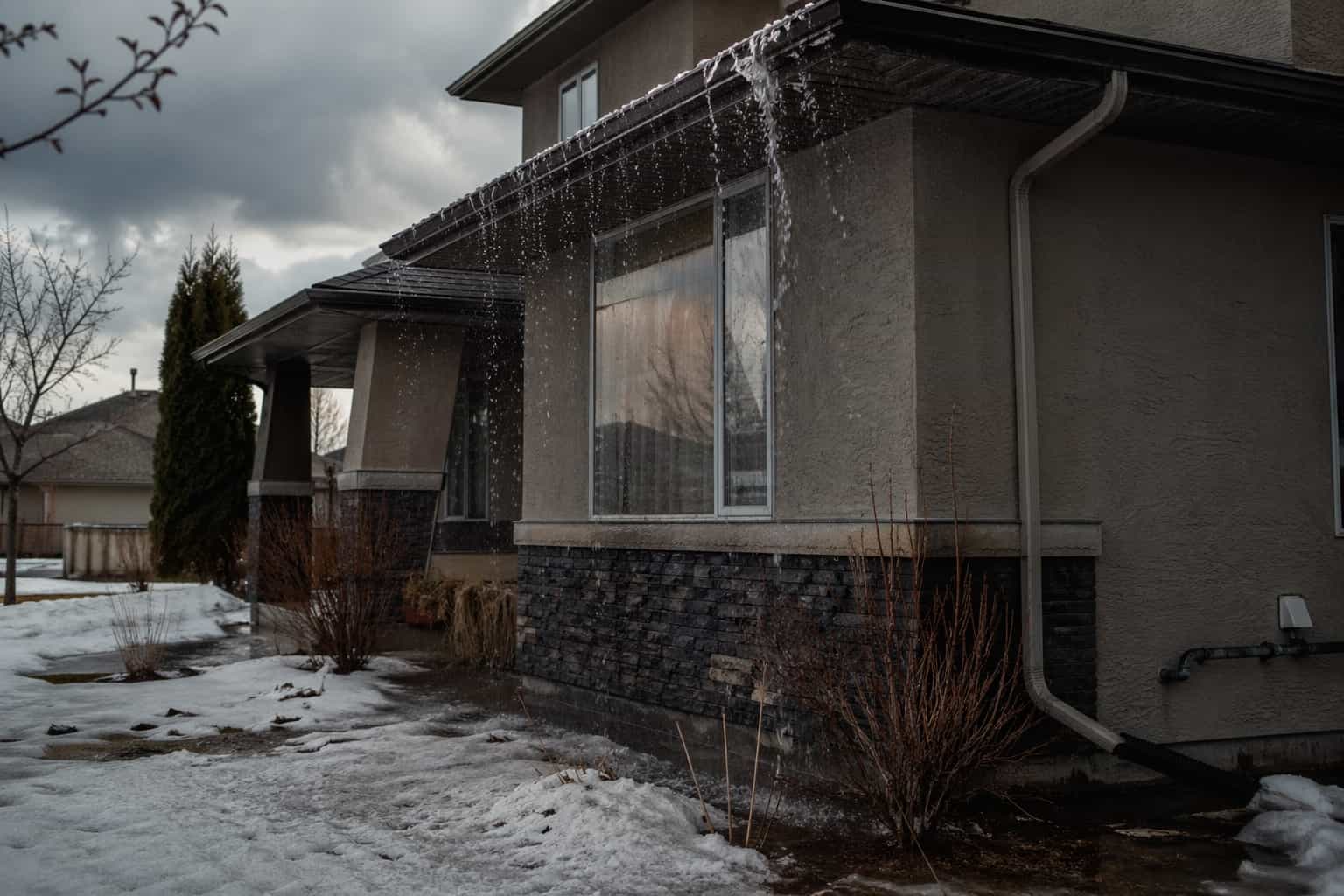
Yes, they can. Gutters exist for one reason: to move water away from your home. When they become clogged, water spills over the sides and ends up right beside the foundation. Over time, that extra moisture can contribute to soil movement, basement seepage, erosion, and expensive foundation repairs.
Not every clogged gutter leads to foundation damage, but every foundation problem caused by roof runoff starts with water going somewhere it shouldn't.
The challenge for homeowners is figuring out which category they fall into. A lot of people assume they need new gutters when they don't, while others keep paying for repairs on a system that should have been replaced years ago.
Most People Don't Connect the Two
I can't count how many times I've stood in a backyard with a homeowner who is dealing with water in their basement and never once considered their gutters might be part of the problem.
To be fair, it's not an obvious connection. The gutters are up on the roof. The problem is down in the basement. Most people assume those things have nothing to do with each other.
But when you think about what happens during a rainstorm, it starts to make sense. Every drop of water that lands on your roof has to go somewhere. On an average home, that's a surprising amount of water moving through the gutter system during even a moderate rainfall.
When the gutters are working properly, that water gets collected, directed into downspouts, and discharged away from the house. When they're clogged, gravity takes over and the water simply pours over the nearest edge.
Unfortunately, the nearest edge is usually right beside the foundation.
What I Usually See First
Most homeowners don't call because they're worried about their foundation. They call because they've noticed something else.
Maybe there's a trench forming in a flower bed below the gutter. Maybe mulch keeps washing away after every storm. Sometimes it's a splash mark on the siding or a muddy area that never seems to dry out.
Those are the early warning signs.
The water is already escaping the gutter system and concentrating in one area. The foundation problem hasn't happened yet, but the conditions that create foundation problems are starting to develop.
Why Edmonton Homes Need to Pay Attention
Edmonton puts homes through a lot every year.
We spend months accumulating snow on our roofs, then spring arrives and all that moisture has to go somewhere. Add a few heavy summer rainstorms and suddenly you've got thousands of litres of water moving around your property over the course of a season.
If even a portion of that water keeps ending up beside the foundation year after year, the ground around the home changes.
Soils become saturated. Areas settle differently. Water finds pathways into places where it wasn't getting before.
This isn't something that happens overnight. It's usually a slow process that develops over several seasons.
A Homeowner We Met Last Spring
Last spring we looked at a house where the owner was concerned about a damp area in the basement. Nothing major. Just a small section of wall that seemed to get wet during heavy rain.
Outside, there was a large flower bed directly below a front gutter. The homeowner had replanted part of it twice because the soil kept washing away.
The problem became obvious as soon as we looked at the gutter system.
The downspout was plugged solid with debris, and every rainfall was sending water over the front edge instead. The homeowner had actually become so used to seeing the waterfall during storms that they didn't think much of it anymore.
Meanwhile, all that water was landing in exactly the same spot beside the foundation.
The basement issue wasn't being caused by a major structural defect. It was being encouraged by years of uncontrolled roof runoff.
It's Not Just Basement Water
When people hear "foundation damage," they often picture huge cracks and expensive repairs.
Sometimes it gets that serious, but there are a lot of smaller issues that show up first.
You might notice concrete settling around the house. You might see walkways shifting. You might find that areas near the foundation stay wet long after the rest of the yard has dried out.
These things don't automatically mean you have foundation damage, but they do tell you that water isn't being managed properly.
And when water isn't managed properly, it tends to create more problems over time, not fewer.
The Good News
The good news is that clogged gutters are one of the easiest home maintenance issues to fix.
In many cases, a thorough cleaning and inspection is all that's needed. Sometimes a downspout needs to be cleared. Sometimes a section has shifted and needs adjustment.
Compared to foundation repairs, these are relatively small jobs.
That's why it makes sense to deal with drainage problems while they're still drainage problems.
Final Thought
Your foundation never sees the rain that falls on your roof. It only sees the water that wasn't properly controlled.
That's really what gutters are doing. They're not there to protect the roof. They're there to protect everything underneath it.
If water is spilling over the sides of your gutters every time it rains, don't assume it's just a cleaning issue. It might be your house giving you an early warning that water is ending up somewhere it doesn't belong.
Not sure what your gutters need?
Book a free inspection and we'll tell you straight, no upsell.
Get a Free Inspection