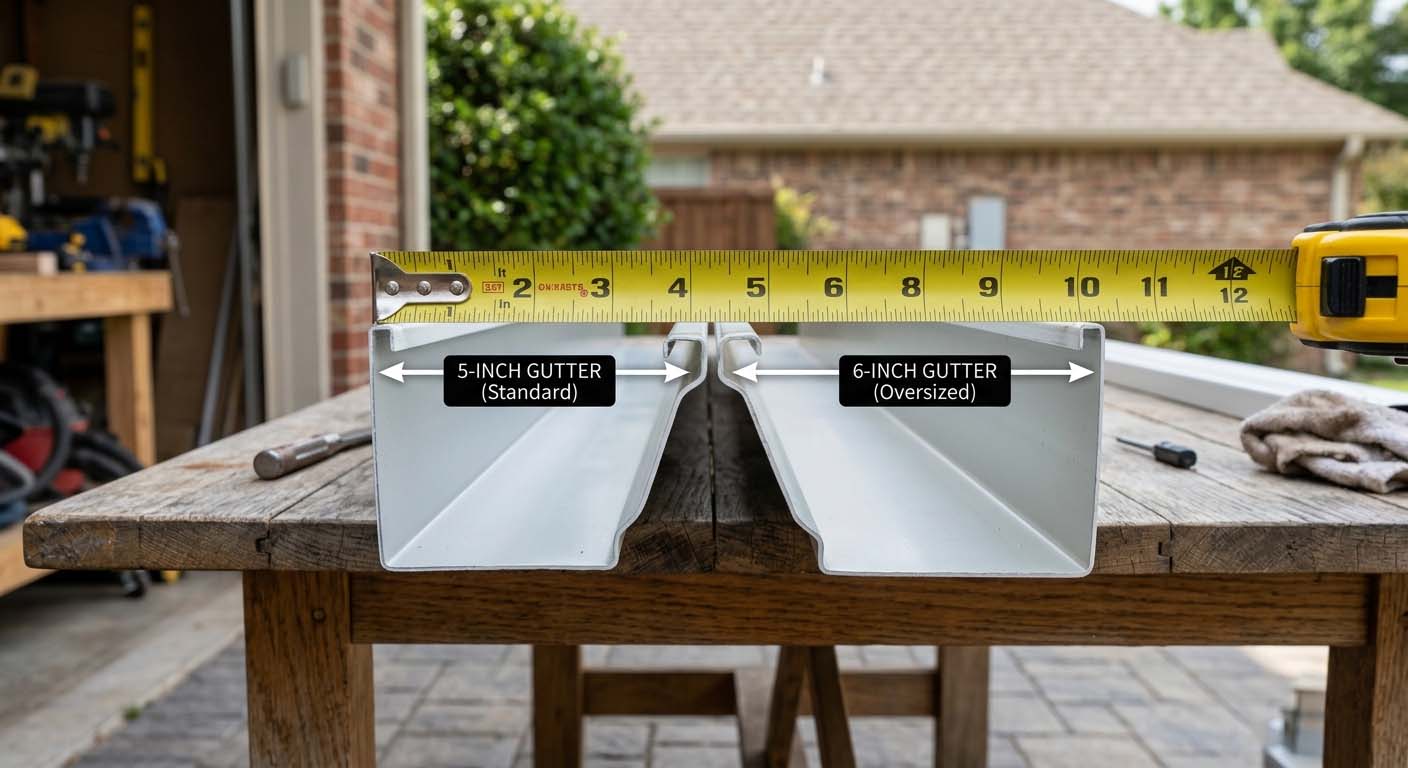
For many Alberta homes, 5-inch gutters are perfectly adequate and remain the most common residential option, while 6-inch gutters are mostly found in commercial settings. However, homes with large roof surfaces, steep roof pitches, multiple valleys, or heavy water runoff often benefit from upgrading to 6-inch gutters. A 6-inch system can handle significantly more water volume, reducing the risk of overflow during heavy rainstorms and rapid spring snowmelt.
If you're replacing your eavestroughs, you've probably come across the question of gutter size. Most homeowners focus on color, material, and price, but the actual size of the gutter can have a major impact on how well your drainage system performs.
Throughout Edmonton, Sherwood Park, St. Albert, Spruce Grove, Leduc, Beaumont, and Fort Saskatchewan, one of the most common conversations we have during estimates is whether a homeowner should stick with standard 5-inch gutters or upgrade to a 6-inch system.
The answer depends on your home, your roof design, and how much water your gutters need to manage.
What Does Gutter Size Actually Mean?
When contractors talk about 5-inch or 6-inch gutters, we're referring to the width of the gutter opening. The larger the gutter, the more water it can collect and move toward the downspouts.
While one inch may not sound like much, the increase in capacity is significant. A 6-inch gutter doesn't just hold slightly more water—it can handle substantially greater volumes during peak runoff conditions.
That's why commercial buildings and larger residential properties often use oversized systems.
Why Gutter Capacity Matters in Alberta
Alberta homes experience drainage challenges that many other parts of North America don't.
In addition to rainstorms, our gutters must manage rapid snowmelt, freeze-thaw cycles, ice buildup, and sudden weather changes. It's not unusual for Edmonton homeowners to see large amounts of runoff during spring when several inches of snow begin melting quickly.
If the gutter system can't handle the volume, water starts overflowing over the front edge or spilling behind the eavestrough.
Over time, that excess water can contribute to fascia damage, landscaping erosion, basement moisture issues, and foundation problems.
When 5-Inch Gutters Are the Right Choice
For many homes, 5-inch gutters work extremely well.
Standard-sized gutters are typically sufficient for average bungalows, standard two-storey homes, and properties with relatively simple roof designs.
If your roof has moderate slopes, limited valley areas, and a reasonable amount of runoff, a properly installed 5-inch seamless gutter system can provide decades of reliable performance.
In fact, most of the homes we service throughout Edmonton and surrounding communities still use 5-inch systems successfully.
Proper installation, correct slope, and adequate downspout placement are often more important than simply increasing gutter size.
When 6-Inch Gutters Make Sense
There are certain situations where upgrading to 6-inch gutters is absolutely worth considering.
Larger homes with expansive roof surfaces naturally generate more runoff. The same is true for homes with steep roof pitches, where water reaches the gutter faster and with greater force.
Roof valleys are another major factor. Valleys concentrate water from multiple roof sections into a single location, creating extremely high-flow areas during storms and snowmelt.
We've installed numerous 6-inch systems on newer homes in Beaumont, Fort Saskatchewan, and parts of Spruce Grove where modern architectural designs create large drainage demands that can overwhelm standard gutters.
Real Job Example: Beaumont Home with Overflow Problems
A homeowner in Beaumont contacted us after experiencing repeated overflow during heavy summer storms.
Their existing 5-inch gutters were in good condition, but the home's large roof valleys were funneling enormous amounts of water into a few key sections of the system.
During intense rainfall, the gutters simply couldn't keep up.
After evaluating the drainage requirements, we upgraded the critical sections to a 6-inch system with larger downspouts. The difference was immediate. Water that had previously overflowed now flowed through the system properly, even during heavy storms.
Don't Forget About Downspouts
One mistake homeowners sometimes make is focusing only on gutter size.
Even the largest gutter won't perform properly if the downspouts can't move the water away efficiently.
When we install 6-inch gutters, we often recommend larger downspouts as well. The goal is to create a balanced drainage system where every component works together.
Increasing gutter capacity without addressing downspout capacity can limit the benefits of the upgrade.
Local Case Study: St. Albert Homeowner Avoids Unnecessary Upgrade
Not every project requires bigger gutters.
We recently inspected a home in St. Albert where the homeowner assumed they needed 6-inch gutters because of occasional overflow.
During our inspection, we discovered the real problem was a partially blocked downspout and an improperly sloped gutter section. The existing 5-inch system was actually large enough for the home's drainage requirements.
After cleaning the system and correcting the slope, the overflow issue disappeared.
This saved the homeowner thousands of dollars and highlights why a proper inspection is important before deciding on upgrades.
What About Snow and Ice?
Many homeowners assume larger gutters automatically perform better in winter.
While 6-inch gutters can handle more water during snowmelt, they are not a cure for ice dam problems or poor attic ventilation.
Ice formation is usually related to heat loss from the home, roof design, and weather conditions—not gutter size alone.
However, larger gutters can provide additional capacity during rapid spring melt, which is one reason they're becoming more common on larger Alberta homes.
Cost Differences Between 5-Inch and 6-Inch Gutters
Upgrading to 6-inch gutters generally increases both material and installation costs. Larger gutters require more aluminum, larger accessories, and often larger downspouts.
The exact difference varies by project, but many homeowners find the upgrade worthwhile when their roof design demands additional drainage capacity.
For homes that don't require the extra capacity, a properly installed 5-inch system often provides better value.
The Bottom Line
There is no one-size-fits-all answer when it comes to gutter sizing. For many homes throughout Edmonton, Sherwood Park, St. Albert, Spruce Grove, Leduc, Beaumont, and Fort Saskatchewan, 5-inch gutters remain an excellent choice.
However, larger homes, steep roofs, heavy runoff areas, and complex roof designs often benefit from the increased capacity of a 6-inch system.
The best way to choose the right size is to evaluate your home's specific drainage requirements rather than simply selecting the largest option available.
Request Your Free Quote
Not sure whether your home needs 5-inch or 6-inch gutters? Catch It All provides professional gutter inspections, installations, and replacements throughout Edmonton, Sherwood Park, St. Albert, Spruce Grove, Leduc, Beaumont, and Fort Saskatchewan. Contact us today for a free quote and we'll recommend the right system for your home.
Not sure what your gutters need?
Book a free inspection and we'll tell you straight, no upsell.
Get a Free Inspection